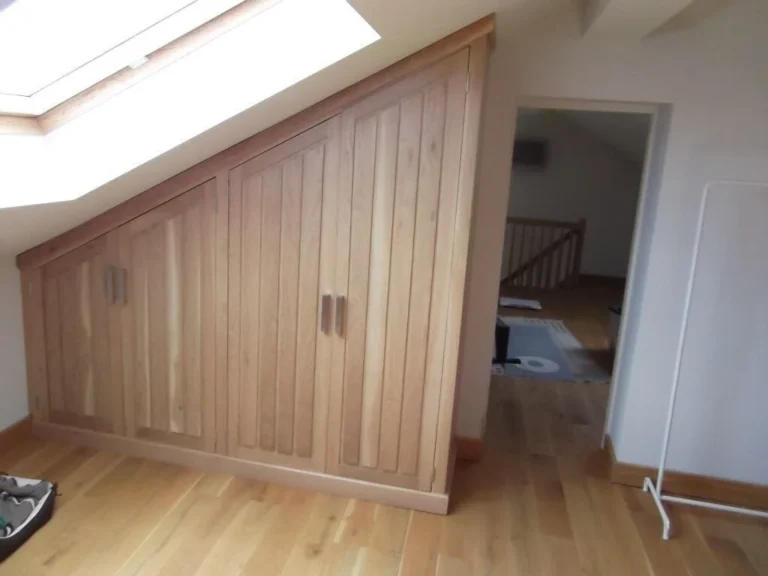
One of the first decisions you’ll make when planning a fitted wardrobe is the door type. It sounds like a small detail, but it actually affects how much usable floor space you have, how the wardrobe looks, and how well it works day to day. Here’s a proper breakdown of sliding versus hinged doors, so you can pick the right one for your room.
How They Differ
Hinged doors open outward on hinges, just like a regular cupboard or room door. You need clearance in front of the wardrobe for the doors to swing open fully.
Sliding doors run on a track and slide left and right across the front of the wardrobe. They don’t swing open at all, so there’s no need for extra clearance space in front.
Pros of Hinged Doors
- Full access at once. With hinged doors open, you can see and reach the entire wardrobe interior in one go, which some people find more practical for getting dressed.
- Wider range of finishes and detailing. Hinged doors can take panelling, mouldings, and traditional detailing more easily, so they tend to suit period or classic-style homes.
- No sliding track to maintain. There’s no mechanism to keep smooth or replace over time.
- Often the more affordable option, particularly for straightforward designs.
Cons of Hinged Doors
- They need clearance space. A door swinging open needs room in front of it, which can be a real problem in a small bedroom.
- Not ideal near beds or furniture. If a bed or chest of drawers sits close to the wardrobe, hinged doors can become awkward or even impossible to open fully.
Pros of Sliding Doors
- Space saving by design. Sliding wardrobes are ideal when space is a constraint, since their doors slide open rather than requiring the clearance that hinged doors need. This frees up floor space for other furniture.
- Great for small bedrooms. They’re a strong choice for compact London bedrooms specifically because they don’t need extra room for doors to swing open.
- A sleeker, more contemporary look. Handleless or mirrored sliding doors give a smooth, modern finish that suits smaller rooms particularly well.
- Mirrored options add light and space. Mirrored sliding doors are often made with safety glass, which is also less prone to breaking than standard glass, making them a safer choice in homes with children. A full mirror finish also bounces light around the room and creates the illusion of more space.
Cons of Sliding Doors
- Partial access only. Since one door covers part of the wardrobe while it’s open, you can’t see and reach the whole interior at once.
- Track and rollers need good quality mechanisms. Cheaper sliding systems can feel stiff or noisy over time, so it’s worth investing in a well-made track.
- Slightly less scope for decorative detailing compared to hinged doors, since the design tends to favour flat, clean surfaces.
Which One Suits a Small Room?
For most small London bedrooms, sliding doors are usually the better fit. The main reason is simple: no clearance space needed. In a small room, that reclaimed floor space can be the difference between a room that feels tight and one that feels comfortable to move around in.
Mirrored sliding doors add a second benefit for small rooms too, bouncing natural light around and making the space feel larger than it is, without adding a single extra centimetre of floor area.
Hinged doors still have their place. If you have a larger bedroom with clearance to spare, prefer full access to your wardrobe at a glance, or want a more traditional look with panelled or decorative doors, hinged designs remain a solid choice.
Our Recommendation
There’s no single right answer, it depends on the room. As a general rule:
- Small or awkward-shaped bedroom: go sliding
- Larger room with space to spare: either works, choose based on style preference
- Period property with traditional detailing: hinged doors often suit the aesthetic better
- Want a bright, contemporary feel: mirrored sliding doors are hard to beat
The best way to know for certain is to see it in your own room. At FWAB, our free design consultation includes a designer visiting your home, measuring the space, and showing you exactly how each door type would work before you decide.
Book your free design visit today and find the right wardrobe doors for your space.